The Taj Mahal is often described as a symbol of eternal love. While that is true, reducing it to only a romantic monument overlooks its deeper meaning. The Taj Mahal is also a statement of imperial authority, a theological vision of paradise, a masterpiece of engineering, and the finest expression of Mughal artistic achievement.
Standing on the banks of the Yamuna River in northern India, this white marble mausoleum represents the height of architectural sophistication during the reign of the Mughal emperor Shah Jahan. Completed in the 17th century, it continues to shape global perceptions of India and remains one of the most studied monuments in architectural history.
Political and Historical Context: The Mughal Golden Age
To understand the Taj Mahal deeply, we must first understand the Mughal Empire during Shah Jahan’s reign (1628–1658).
The Mughal Empire was one of the richest and most powerful empires in the world at that time. Its court was known for:
- Military strength
- Economic prosperity
- Artistic excellence
- Architectural innovation
Shah Jahan’s reign is often considered the golden age of Mughal architecture. Before the Taj Mahal, Mughal architecture had already evolved through monuments like Humayun’s Tomb and Akbar’s tomb complex. However, Shah Jahan refined architectural symmetry and marble craftsmanship to perfection.
The Taj Mahal was not just built out of grief for Mumtaz Mahal — it was also a political statement. It reflected imperial wealth, divine legitimacy, and the emperor’s authority.
The Story of Mumtaz Mahal and Imperial Devotion
Mumtaz Mahal, whose real name was Arjumand Banu Begum, was Shah Jahan’s trusted companion and political advisor. She accompanied him even during military campaigns.
In 1631, she died during childbirth in Burhanpur. Her death deeply affected the emperor. Court chronicles describe Shah Jahan as inconsolable for months.
Her body was first buried temporarily in Burhanpur and later transferred to Agra, where construction of the Taj Mahal began in 1632.
But this was not merely a tomb — it was conceived as a celestial palace for her in the afterlife.
Urban Planning and Sacred Geometry
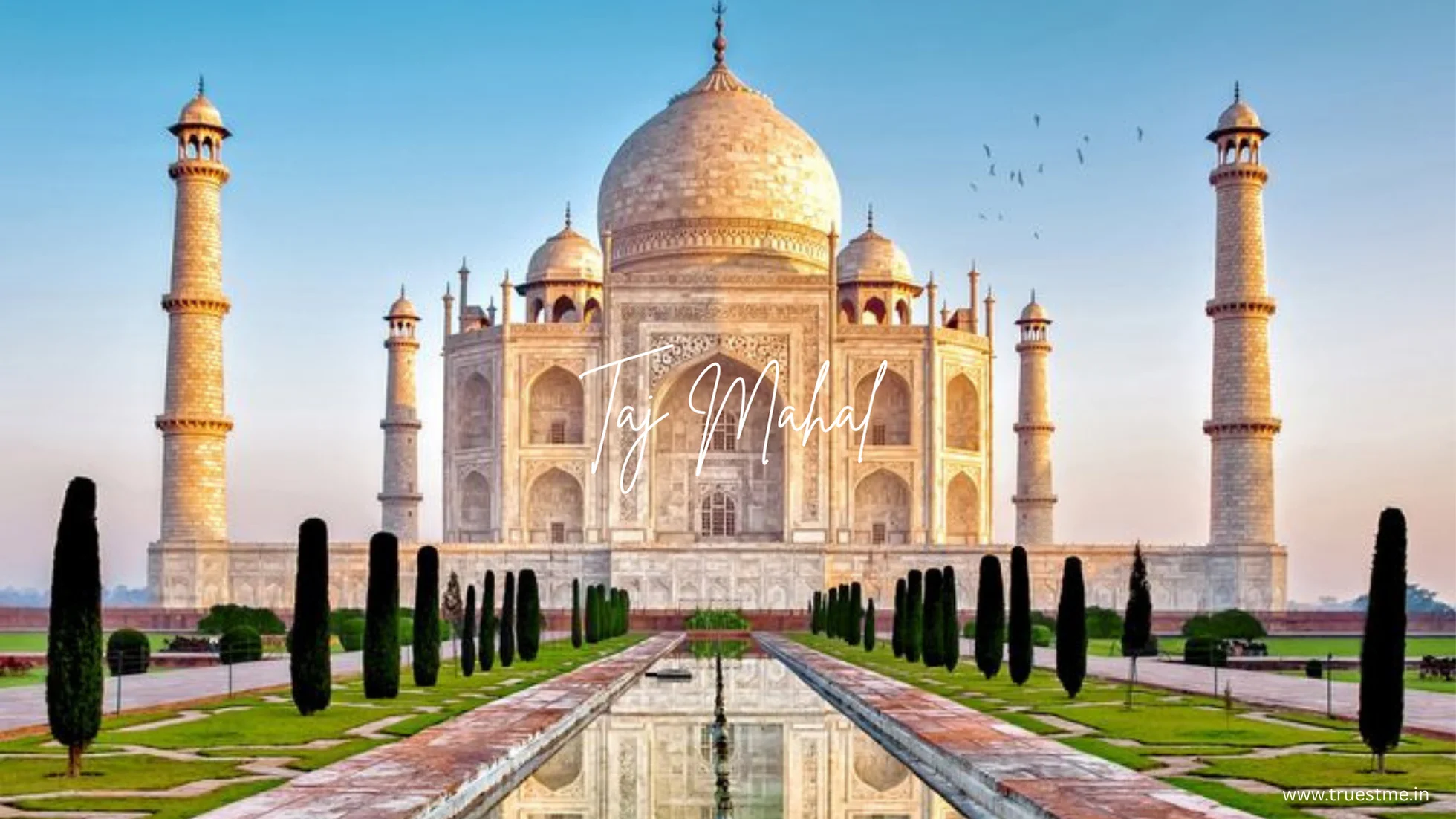
The Taj Mahal complex is not just a single building. It is a carefully planned architectural ecosystem.
The full complex includes:
- The main mausoleum
- A mosque (west side)
- A guest pavilion (east side)
- Grand entrance gate
- Charbagh garden
- Reflecting pool
- Riverfront terrace
Unlike earlier Mughal tombs that were centrally placed in gardens, the Taj Mahal is uniquely positioned at the end of the garden, near the river. This riverfront design was revolutionary.
The Charbagh Concept
The garden follows the Persian charbagh layout — a quadrilateral garden divided by water channels into four sections. This represents the four rivers of Paradise described in Islamic tradition.
The entire layout follows strict proportional geometry. Scholars have noted that its measurements align with precise mathematical ratios, creating visual harmony from every angle.
Architectural Precision and Optical Engineering
Perfect Symmetry
The Taj Mahal is famous for bilateral symmetry. Everything mirrors across the central axis — except one detail:
Shah Jahan’s tomb.
After his death in 1666, he was buried beside Mumtaz Mahal. This slightly disrupted the otherwise perfect symmetry — a fascinating historical shift in design.
The Dome
The central dome rises to approximately 73 meters (240 feet). It is a double-dome structure:
- The inner dome maintains interior proportions
- The outer dome creates monumental height
This double-shell technique enhances acoustics and structural balance.
Minarets
The four minarets:
- Are 40 meters tall
- Slightly lean outward
- Serve both aesthetic and protective functions
Their outward tilt ensures that in case of collapse (such as during an earthquake), they would fall away from the main tomb.
Materials and Global Craftsmanship Network
The Taj Mahal was built using materials sourced from across Asia:
- White marble from Makrana (Rajasthan)
- Lapis lazuli from Afghanistan
- Jade from China
- Turquoise from Tibet
- Carnelian from Arabia
- Sapphire from Sri Lanka
Over 20,000 artisans worked on the monument, including:
- Persian calligraphers
- Ottoman dome specialists
- Indian stone carvers
- Central Asian inlay artists
The decorative inlay technique used is called pietra dura, where semi-precious stones are cut and fitted into marble with microscopic precision.
Even today, the floral inlays appear almost painted — but they are entirely stone.
Calligraphy and Spiritual Messaging
The calligraphy on the Taj Mahal was designed by Amanat Khan Shirazi. Verses from the Quran are inscribed across:
- The main gateway
- The mausoleum entrance
- Interior walls
A brilliant optical illusion was used — the letters increase in size as they go higher. From ground level, they appear uniform in size.
Most verses refer to themes of:
- Divine mercy
- Paradise
- Judgment Day
This reinforces the idea that the Taj Mahal represents a gateway to heaven.
Light, Reflection, and Changing Colors
One of the Taj Mahal’s most fascinating characteristics is how it interacts with light.
The marble surface absorbs and reflects light differently depending on atmospheric conditions:
- Dawn → Soft pink glow
- Midday → Brilliant white
- Sunset → Golden-orange hue
- Moonlight → Silver-blue radiance
This shifting appearance has led many scholars to interpret the monument as symbolizing the changing moods of Mumtaz Mahal — poetic yet architecturally intentional.
Recognition and Global Importance
The Taj Mahal has become a universal icon of architecture.
- Declared a UNESCO World Heritage Site in 1983
- Voted one of the New Seven Wonders of the World in 2007
- Receives millions of visitors annually
It has influenced architectural designs worldwide and remains one of the most photographed monuments on Earth.
Shah Jahan’s Imprisonment and Final Years
In a dramatic political shift, Shah Jahan was deposed by his son Aurangzeb.
He spent his final years imprisoned in Agra Fort, reportedly with a view of the Taj Mahal from his window.
After his death, he was buried next to Mumtaz Mahal inside the mausoleum, fulfilling — in death — the eternal union symbolized by the monument.
Structural Science and Conservation Challenges
Despite its grandeur, the Taj Mahal faces serious threats:
Environmental Damage
Industrial pollution
Acid rain
Yellowing of marble
River Ecology
The Yamuna River’s declining water levels threaten the wooden foundation system, which relies on moisture stability.
Preservation Measures
The Indian government created the Taj Trapezium Zone (TTZ) to limit pollution. Restoration includes periodic mud-pack treatments to clean and restore marble whiteness.
Conservation scientists continue to monitor structural stress, marble degradation, and environmental impact.
Why the Taj Mahal Is More Than a Love Story
The Taj Mahal is:
- A political statement of imperial power
- A theological vision of paradise
- A masterpiece of geometry and optics
- A symbol of artistic globalization in the 17th century
- A living heritage site facing modern challenges
It is not simply a romantic monument.
It is a fusion of love, empire, religion, mathematics, art, and engineering — preserved in luminous marble.
More than 370 years later, it still stands — serene, symmetrical, and almost unreal — reminding humanity that architecture can transcend time.